

Google has started its November 2026 core update, and early search results are showing significant volatility across a range of industries. For businesses that depend on organic visibility, the immediate question is whether those changes will affect the searches, pages and leads that matter most.
The honest answer is that it is too early to know. A core update can change how Google evaluates and ranks content across many searches, but early movement in a third-party tracking tool does not tell us which businesses will gain or lose visibility, or why.
The right response is to monitor the data closely, understand where meaningful changes occur and make informed decisions once there is enough evidence to act.
What We Know About the November Core Update
According to the Google Search Status Dashboard, the November 2026 core update began on November 10 at 10:06 a.m. Pacific time. The update is global, affects all languages and may take up to two weeks to complete.
Google has not announced that the rollout is complete. As of November 11, businesses may see rankings move while the update is still in progress. Some of that movement may settle or change direction before the rollout ends.
Core updates are broad changes to Google’s ranking systems, rather than a simple penalty against a particular website. A page that declines is not necessarily broken or in violation of a policy. It may be competing in a search landscape where Google is weighing relevance and quality differently.
Early Search Volatility and Industry Differences
Semrush Sensor’s November 11 U.S. desktop data shows that search volatility is elevated across much of its tracked industry set. Its Deviations view compares each category’s daily volatility with that category’s own monthly average, making it useful for identifying where movement is unusually high or low.
The snapshot shows:
- 24 of 25 categories were above their own monthly volatility averages.
- Hobbies & Leisure had the largest deviation at +3.3 points, followed by Arts & Entertainment at +3.2.
- Books & Literature, Home & Garden, Real Estate and Science each recorded +3.1 points.
- The all-category reading was +2.8 points above its monthly average. Its overall volatility score was 9.4 out of 10, compared with a displayed monthly average of 6.6.
- Health was the only category below its own monthly average, at −1.6 points. Its overall volatility score was 4.3 out of 10.
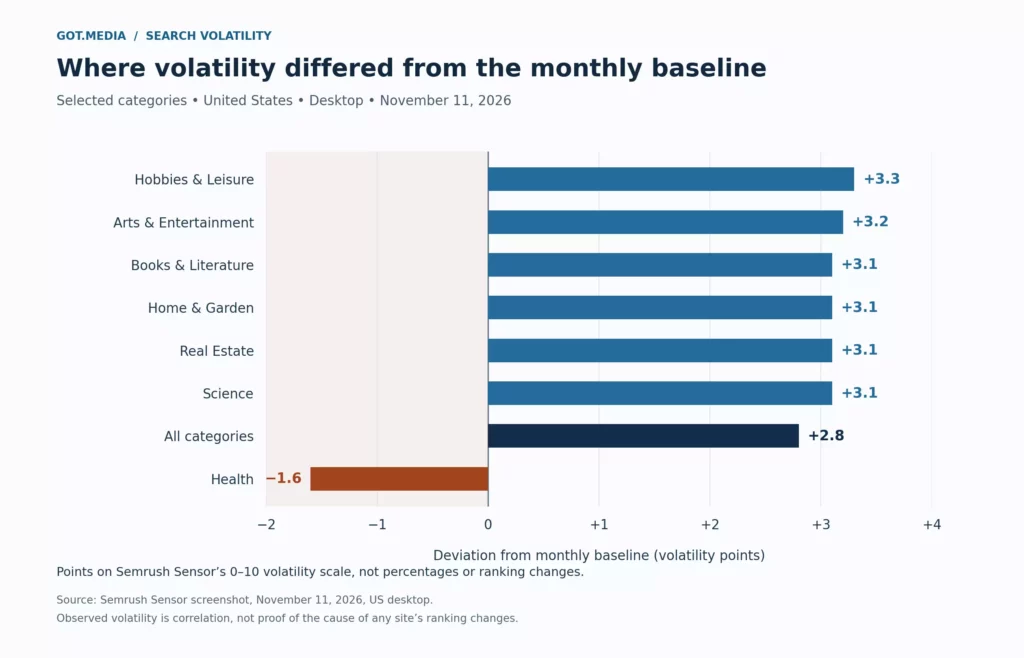
Selected category deviations from each category’s monthly volatility average, U.S. desktop results, November 11, 2026. Source: Semrush Sensor. Chart based on the supplied November 11 screenshot.
These are Sensor score points, not percentages, ranking losses or traffic changes. Health’s lower reading does not mean healthcare websites are unaffected, and above-average volatility does not mean every business in an industry lost ground.
The timing also calls for caution. The overview chart shows elevated volatility beginning around October 27, roughly two weeks before Google announced the November core update. The Sensor data does not establish that the update caused all of the observed movement.
Semrush also recently described an issue affecting some automated search results and the steps it is taking to filter and recollect data. That does not establish that this specific reading is inaccurate, but it reinforces the need to compare third-party tracking with first-party performance data before drawing conclusions.
What Businesses Should Watch During the Rollout
A single keyword movement rarely tells the whole story. The more useful question is whether a business is gaining or losing visibility across important pages and searches, and whether that movement is affecting qualified traffic and conversions.
For example, a local service company may see an important service keyword fall several positions while another page gains visibility for a different service. An industry-wide volatility score will not explain whether the net effect is fewer calls, better-qualified leads or no material business change at all.
The same applies to professional services. A decline in visits to an informational article may be less consequential than a smaller decline on a high-intent service page that regularly generates inquiries. Both deserve investigation, but they should not automatically receive the same priority.
Location, device, branded versus non-branded searches, and changes in search demand also matter. A drop that appears significant at the site level can look different when the data is separated by page and query.
How We Are Helping Customers
At Got.Media, we are monitoring each customer’s Search Console data, keyword movement and other available performance signals throughout the rollout. We are looking for meaningful changes in impressions, clicks, rankings and landing-page traffic, then comparing those changes with leads, calls and other conversion data where tracking is available.
When we identify a sustained decline, we will investigate the affected pages and queries alongside technical access, content quality, search intent and the competitive results. That gives us a more useful starting point than changing pages simply because a tracking tool shows volatility.
Where a problem or opportunity is supported by the evidence, we will recommend a targeted response. That may involve improving an existing page, addressing a technical issue, strengthening useful information or adjusting how a topic is covered. The objective is to restore lost visibility where possible and improve the overall search presence, without promising an immediate recovery or a particular ranking.
We will also look for gains. An update can reveal content that is becoming more visible, questions a business is well positioned to answer and pages that deserve additional attention.
Why Timing Matters Before Making Major Changes
Monitoring should begin now, but the best time for a full before-and-after assessment is after the rollout finishes. In its core update guidance, Google recommends waiting at least a full week after completion before comparing Search Console performance with a period before the update.
That does not mean ignoring a serious technical problem during the rollout. If a key page becomes inaccessible, tracking breaks or a site is accidentally blocked, those issues deserve prompt attention. It does mean avoiding a rushed rewrite of otherwise useful content based on a few days of unstable rankings.
The difference matters because search changes have more than one possible cause. Seasonality, site releases, competitor activity, demand changes and tracking issues can all affect performance. Separating those factors takes more care than attributing every movement to the latest Google update.
What Happens Next
The November core update is still underway, and the early industry data points to substantial movement in many tracked search results. It does not yet tell us which changes will last or what every affected business should do.
We will continue monitoring customer performance as the rollout progresses. Once there is enough reliable data to distinguish temporary movement from meaningful changes, we will share what we are seeing, explain the potential impact and recommend the next steps that make sense for each business.